

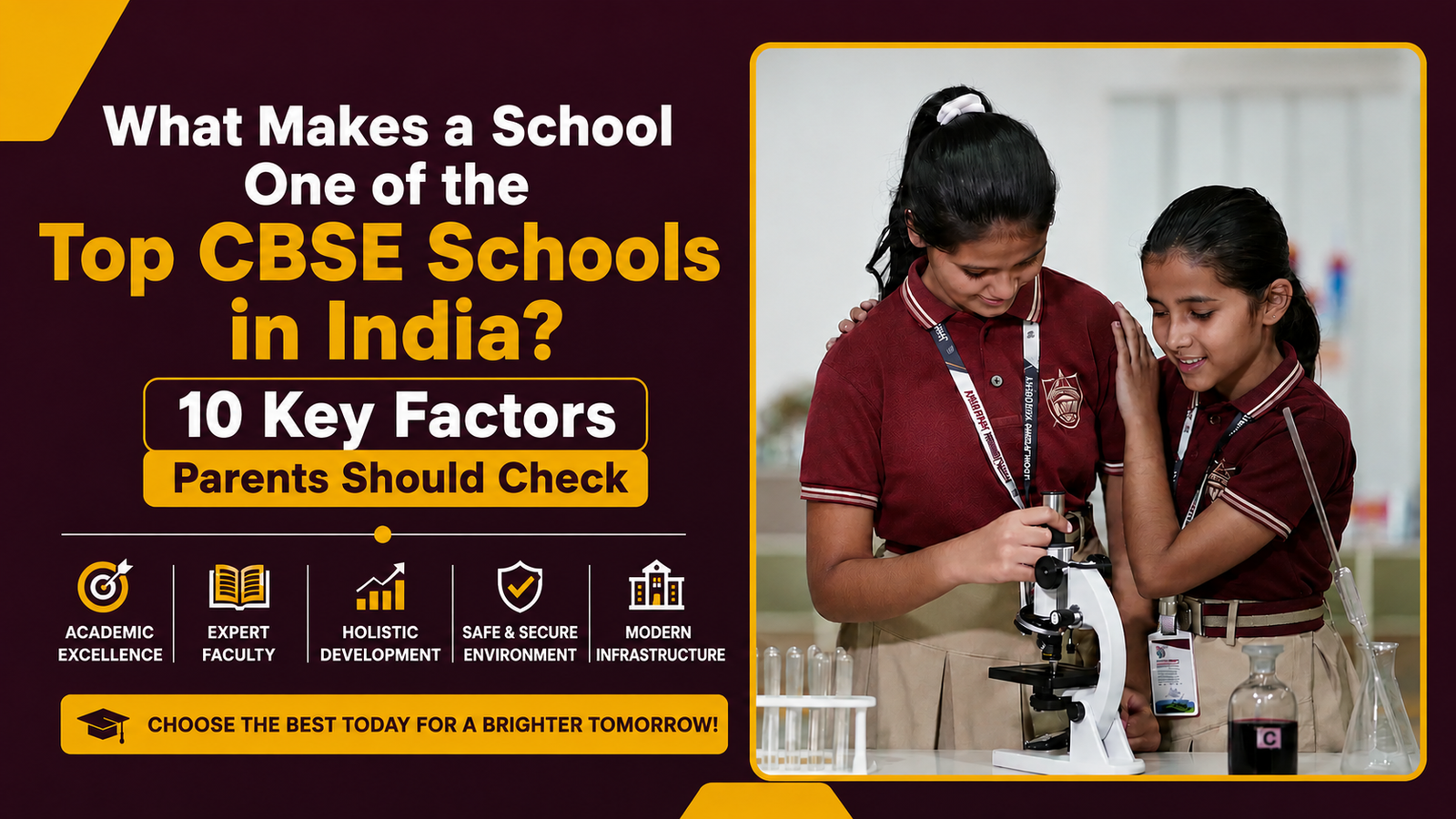
Choosing the right school is one of the most important decisions parents make for their child. With thousands of CBSE schools in India, it can be difficult to identify a school that genuinely provides quality education, strong academic support, and opportunities for overall development. A high position in a CBSE school ranking may offer an initial reference, but it should not be the only consideration.
Parents should evaluate academics, teachers, teaching methods, infrastructure, safety, technology, extracurricular activities, student support, and future preparation. Understanding what makes a school one of the top CBSE schools in India helps parents make a more informed decision and choose a learning environment that matches their child’s needs.
How to Identify a Top CBSE School in India?
To identify a top CBSE school, parents should look beyond advertisements, popularity, and examination results. A quality school should demonstrate consistency across academics, teaching quality, student development, facilities, safety, and extracurricular opportunities.
When comparing the best CBSE schools in India, parents should understand how students are taught, supported, assessed, and encouraged to participate beyond the classroom. A strong school focuses on conceptual understanding, practical learning, communication, creativity, discipline, and problem-solving.
Parents can also visit shortlisted campuses and interact with teachers or school representatives. Observing classrooms, checking facilities, understanding student support systems, and asking about academic and extracurricular opportunities can provide valuable insights.
For example, when evaluating institutions such as Modi School, parents can consider the overall educational approach rather than focusing on one feature alone. Similarly, Modi World School can be assessed against the same criteria that parents use to compare other quality CBSE schools.
10 Key Factors Parents Should Consider
1. Academic Performance
Academic performance is one of the first factors parents consider while evaluating top CBSE schools in India. Parents should look at CBSE board results, academic consistency, student progress, assessment methods, and the school’s approach to conceptual learning. However, marks should not be the only measure of quality. A strong academic environment helps students understand concepts, develop problem-solving abilities, and build a foundation for higher education and competitive examinations. Consistent academic guidance can also encourage students to become confident and independent learners.
2. Qualified Teachers
Teachers have a direct impact on a child’s learning experience. One of the important characteristics of leading CBSE schools in India is a team of qualified, experienced, and dedicated educators. Parents should consider teacher qualifications, subject expertise, experience, communication skills, and the ability to support different learning needs. Good teachers can simplify difficult concepts, encourage questions, identify learning gaps, and provide constructive feedback. Institutions such as Modi World School can be evaluated by parents through the quality of their faculty and the learning support offered to students.
3. Teaching Methods
Modern education requires more than traditional textbook-based teaching. Parents should check whether schools use activity-based learning, experiential learning, projects, discussions, practical activities, and technology-supported lessons.
A student-centric methodology can make classrooms more interactive while encouraging curiosity, creativity, critical thinking, and independent learning. When comparing a Modi School with other institutions, parents can examine how teaching strategies are used to help students understand concepts and apply knowledge in real situations. Effective teaching should focus on learning outcomes rather than simply completing the syllabus.
4. Infrastructure & Facilities
Quality infrastructure plays an important role in creating a productive learning environment. Parents evaluating quality CBSE schools in India should check classrooms, science laboratories, libraries, computer facilities, activity rooms, sports infrastructure, sanitation, and other essential resources.
Modern infrastructure should have an educational purpose rather than simply look attractive. Well-equipped facilities can provide students with opportunities to experiment, conduct practical activities, participate in sports, explore creative interests, and learn beyond textbooks. While visiting a Modi World School, parents can assess whether available facilities are properly maintained and actively support student learning.
5. Sports & Extracurricular Activities
Education is not limited to academic subjects. Sports and extracurricular activities help students develop teamwork, leadership, communication, creativity, confidence, discipline, and time-management skills.
Parents looking for the best CBSE school in India should check opportunities for sports, music, arts, debates, competitions, clubs, cultural activities, and other interests. A balanced school environment gives students opportunities to discover their strengths outside the classroom. A Modi School can also be evaluated by looking at how effectively students are encouraged to participate in activities alongside their academic responsibilities.
6. Safety & Student Wellbeing
Students learn more effectively when they feel safe, respected, and supported. Parents should evaluate campus security, transportation safety, hygiene, emergency procedures, supervision, and systems for addressing student concerns.
A top CBSE school should also consider emotional and social wellbeing. Children may experience academic pressure, social challenges, or difficulties adjusting to new environments. A supportive atmosphere allows students to communicate their concerns and seek appropriate guidance. When considering Modi World School or any other institution, parents should understand the systems in place to create a safe and positive learning environment.
7. Technology & Digital Learning
Technology has become an important component of modern education. Top schools in India may use smart classrooms, digital resources, educational platforms, multimedia content, and technology-supported activities to make learning more engaging.
However, technology should complement effective teaching rather than replace teacher interaction. Parents should understand how digital resources are integrated into classroom learning and whether students are taught responsible technology use. A future-focused Modi School approach can be assessed by considering how technology supports conceptual learning, research skills, digital literacy, collaboration, and problem-solving.
8. Individual Student Support
Every student has different strengths, interests, learning speeds, and academic challenges. Individual attention is therefore an important factor when evaluating the best schools in India.
Parents should ask how teachers monitor student progress, identify learning gaps, solve doubts, and provide additional support when necessary. Mentoring, personalised feedback, remedial assistance, and regular progress discussions can help students improve. Modi World School can be compared with other schools by examining how effectively teachers recognise individual student needs and provide appropriate academic and personal guidance.
9. Career Guidance
School education should prepare students for future opportunities, not just examinations. Career guidance can introduce students to different academic streams, professional courses, competitive examinations, and career options.
Parents should check whether a school provides counselling, aptitude guidance, subject-selection support, and exposure to different career paths. For students interested in engineering, medicine, technology, management, research, or other professional fields, timely guidance can help them make informed decisions. A Modi School can be evaluated on how well its educational environment helps students understand their strengths and make thoughtful choices about their future.
10. Parent-School Communication
Effective communication between parents and teachers creates a stronger support system for students. Parents should understand how schools share academic progress, attendance, achievements, behaviour-related observations, and important updates.
Parent-teacher meetings, digital communication, feedback systems, and regular interaction can help families stay informed. A transparent relationship also allows teachers and parents to address concerns together. While evaluating Modi World School, parents can consider how communication is managed and whether families receive meaningful information about their child’s academic and personal development.
Top CBSE School vs Average School
The difference between a top CBSE school and an average school is not necessarily determined by board examination results alone. Academic performance is important, but a genuinely strong school focuses on the complete educational experience.
An average approach may focus primarily on completing the syllabus and preparing students for examinations. In contrast, the best CBSE schools in India aim to combine academics with communication, creativity, critical thinking, leadership, sports, arts, technology, and personal development.
Parents should therefore avoid choosing a school solely because it appears high in a CBSE school ranking. They should investigate the actual quality of teaching, student support, infrastructure, safety, extracurricular opportunities, and learning environment.
For instance, when comparing a Modi School with another CBSE institution, parents should assess both schools using the same criteria. Similarly, evaluating Modi World School should involve looking at the complete student experience rather than focusing on a single academic statistic.
Another important difference is consistency. A strong school should maintain quality across academics, teaching, facilities, student wellbeing, extracurricular activities, and communication. Ultimately, what factors make a school the best depends on the individual needs and goals of the child.
How Parents Can Compare CBSE Schools
Parents wondering how to choose the best CBSE school in India should create a simple comparison checklist before making a final decision. Start by comparing academic performance, faculty, teaching methodology, infrastructure, safety, extracurricular activities, technology, individual student support, career guidance, and communication.
A campus visit can provide insights that websites and brochures cannot always offer. Parents can observe classrooms, ask about teaching practices, understand teacher-student interaction, and check whether students actively use the available facilities.
Practical factors should also be considered, including location, daily commute, school timings, fee structure, transportation, and admission requirements. A school with a strong reputation may not necessarily be the right fit for every child.
Parents can shortlist multiple CBSE schools in India and compare them using the same criteria. Instead of asking only which school has the highest ranking, parents should ask which school offers the right combination of academics, support, facilities, values, activities, and future opportunities for their child.
Frequently Asked Questions
What makes a school one of the top CBSE schools in India?
A top CBSE school combines academic quality with qualified teachers, effective teaching methods, modern infrastructure, student safety, extracurricular activities, technology, individual support, career guidance, and strong parent-school communication. Together, these factors create a balanced environment that supports academic achievement and overall student development.
How do I choose the best CBSE school in India for my child?
Parents should compare academics, teachers, teaching methods, infrastructure, safety, extracurricular activities, student support, career guidance, fees, location, and school culture. Visiting shortlisted schools and understanding their educational approach can also help parents determine which environment best matches their child’s learning needs and future goals.
What factors should parents consider when choosing a CBSE school?
Parents should consider academic performance, teacher quality, teaching methodology, infrastructure, safety, sports, extracurricular activities, technology, individual attention, career counselling, communication, fees, location, and the overall learning environment.
Are CBSE board results enough to identify a top school?
No. CBSE board results are an important indicator of academic performance, but they are not enough on their own. Parents should also evaluate teaching quality, student development, facilities, extracurricular opportunities, safety, individual support, and career preparation.
What facilities should a top CBSE school provide?
A quality CBSE school should ideally provide well-equipped classrooms, laboratories, library resources, technology-enabled learning facilities, sports infrastructure, activity spaces, safe campus facilities, and resources that support academic learning as well as overall student development.
Why is teacher quality important when choosing a CBSE school?
Teachers directly influence how students understand concepts, participate in class, solve problems, and develop confidence. Qualified and experienced teachers can identify learning gaps, provide personalised guidance, encourage curiosity, and create a more engaging and supportive learning environment.
How important are extracurricular activities in a CBSE school?
Extracurricular activities are important because they help students develop teamwork, leadership, creativity, communication, confidence, discipline, and social skills. Sports, arts, music, debates, clubs, and competitions complement academic learning and give students opportunities to discover and develop their interests.
Conclusion
Understanding what makes a school one of the top CBSE schools in India requires parents to look beyond rankings, advertisements, and examination results. Academic performance, qualified teachers, teaching methods, infrastructure, extracurricular opportunities, safety, technology, individual support, career guidance, and parent-school communication all contribute to a strong educational environment.
For families looking for a balanced combination of academics, modern learning, student development, and future readiness, Modi World School – Wisdom City can be considered while evaluating available educational options. Parents can assess its teaching approach, facilities, student support, activities, and overall learning environment alongside other best CBSE schools in India to make a well-informed admission decision.
📞 Admissions Open! Enroll now to shape your child’s bright future with us.
📲 Call: +91-7240372409
📍 Address: Modi World School, Wisdom City, Near Khemi Shakti Temple, Samaspur Road, Jhunjhunu, Rajasthan – 333001
#ModiWorldSchool #CBSESchoolInIndia #BestBoardingSchool #TopBoardingSchool #BestSchoolInIndia #CBSEBoardingSchool #AdmissionsOpen #QualityEducation #BoardingSchoolIndia #ResidentialSchool #FutureReadyEducation #BoardingSchoolLife #TopCBSERajasthan #ModernEducation #CBSEIndia #SchoolAdmissions